Between Google Scholar and ChatGPT: How Students Conduct Research in 2026
Google Scholar remains a mainstay, ChatGPT has become an established research tool, and specialist academic databases continue to play a secondary role for many students. A new ZBW study involving 908 economics and business students examines how literature search is changing, where students encounter difficulties, and what this means for information literacy teaching in libraries.
by Doreen Siegfried (ZBW)

Students in economics and business studies today draw on a wide range of information environments when searching for academic literature. Google Scholar, library catalogues and generative AI are part of their everyday research routines. But what role do traditional subject-specific databases still play? And how well do students manage to find information, assess its quality and use it correctly in an academic context?
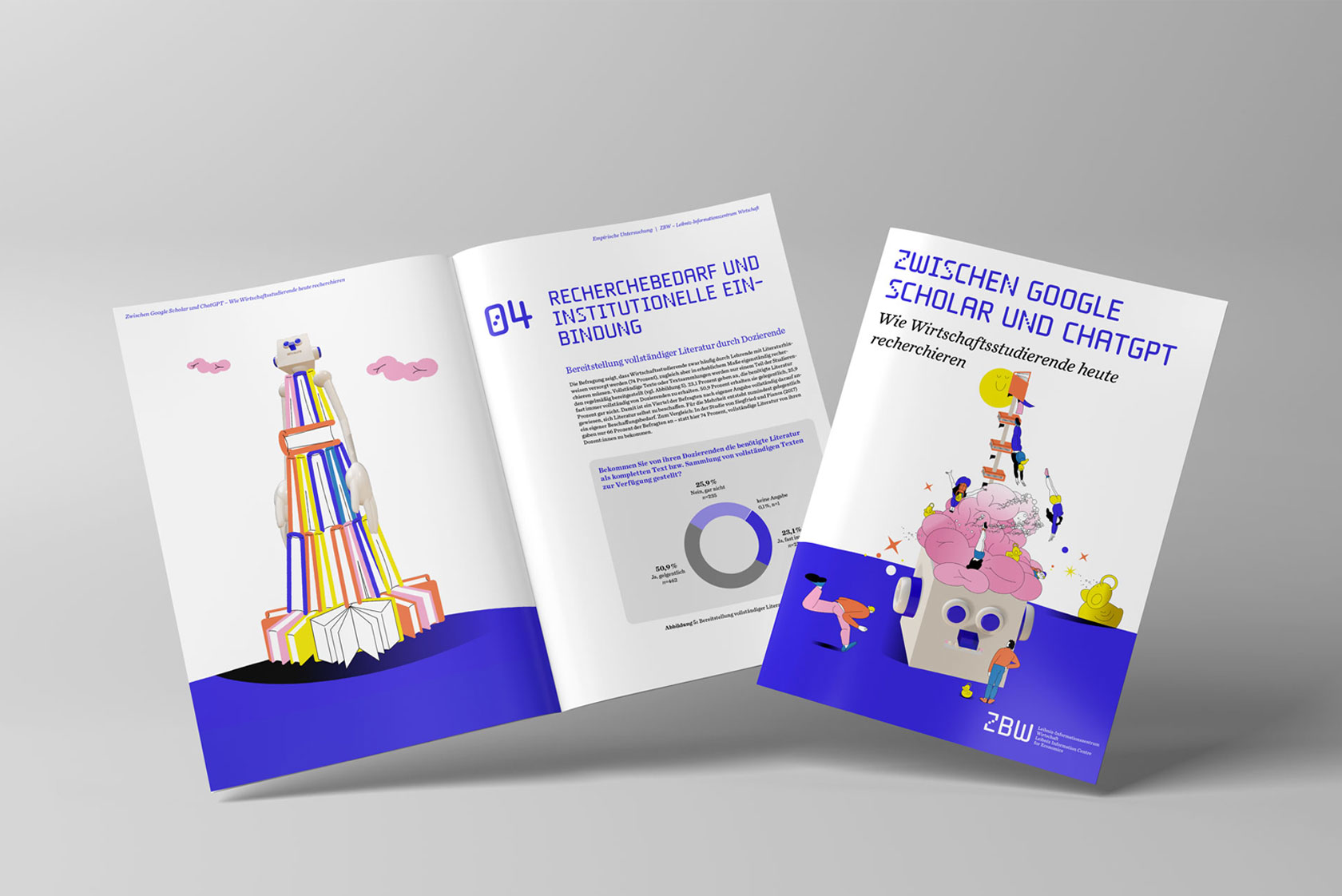
These questions are at the heart of our new study (in German) „Zwischen Google Scholar und ChatGPT – Wie Wirtschaftsstudierende heute recherchieren“ (“Between Google Scholar and ChatGPT – How economics and business students conduct research today”). Between March and May 2026, we conducted an online survey of 908 economics and business students at German universities.
Research habits are shifting
The results show, first of all, that independent literature searching is routine for the vast majority of the surveyed students: 88.3 per cent have searched for literature or specialist information on their own, either frequently or occasionally. General search engines remain the most widely used tools, with 91.3 per cent of those with research experience using Google, Google Scholar or similar services sometimes or often.
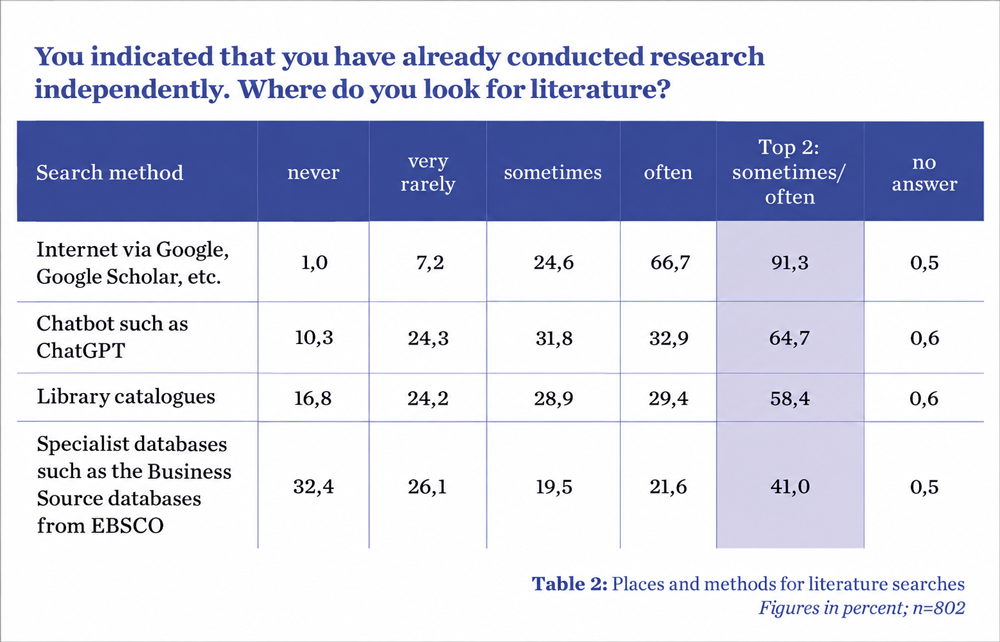
What is new is the prominence of generative AI. Almost two thirds of respondents (64.7 per cent) stated that they sometimes or often use chatbots and general-purpose AI tools such as ChatGPT or Gemini when searching for literature. Notably, specialised AI research tools such as Elicit, Consensus, Connected Papers, ResearchRabbit and SciSpace have so far played a considerably smaller role. It is noteworthy that specialised AI research tools such as Elicit, Consensus, Connected Papers, ResearchRabbit or SciSpace have so far played a smaller role. At just under two-thirds, AI chatbots are already ahead of library catalogues (58.4 per cent) and well ahead of specialised business databases, such as EBSCO databases (Business Source Elite, Premier, Complete, Ultimate), Factiva, JSTOR, Nexis Uni, ProQuest One Business, RePEc or SSRN (41 per cent).
Many specialist databases are not widely known
Why do specialist research resources play a comparatively minor role? Part of the explanation is that many of the students surveyed are simply not aware of them. Around half of respondents are unfamiliar with databases such as Factiva, Nexis Uni, ProQuest One Business or even RePEc. Even long-established academic research platforms such as EconBiz, JSTOR or SSRN are unknown to many of them.
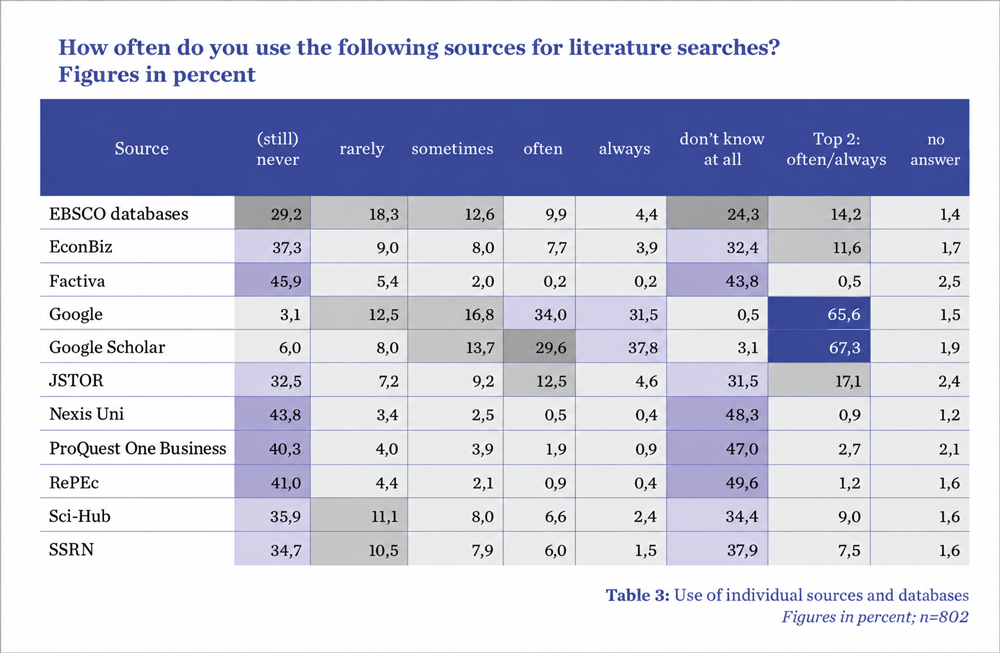
However, this should not be hastily interpreted as a lack of interest in subject-specific information resources. Rather, academic libraries should ask themselves whether the added value of their services is sufficiently apparent in students’ day-to-day research. It might also be worthwhile to reflect critically on our own teaching practices: are we meeting students where they actually are in their research habits? Or do we sometimes approach information literacy from a deficit perspective, focusing on what students do not yet know or are supposedly doing wrong? And do our services genuinely address students’ needs?
AI literacy is now an integral part of information literacy
The role of generative AI now extends well beyond literature searching. As many as 91.5 per cent of respondents use AI applications deliberately and purposefully throughout their studies: to have complex topics explained, to clarify points they have not understood, to analyse texts or to gain an initial overview of a new subject area.
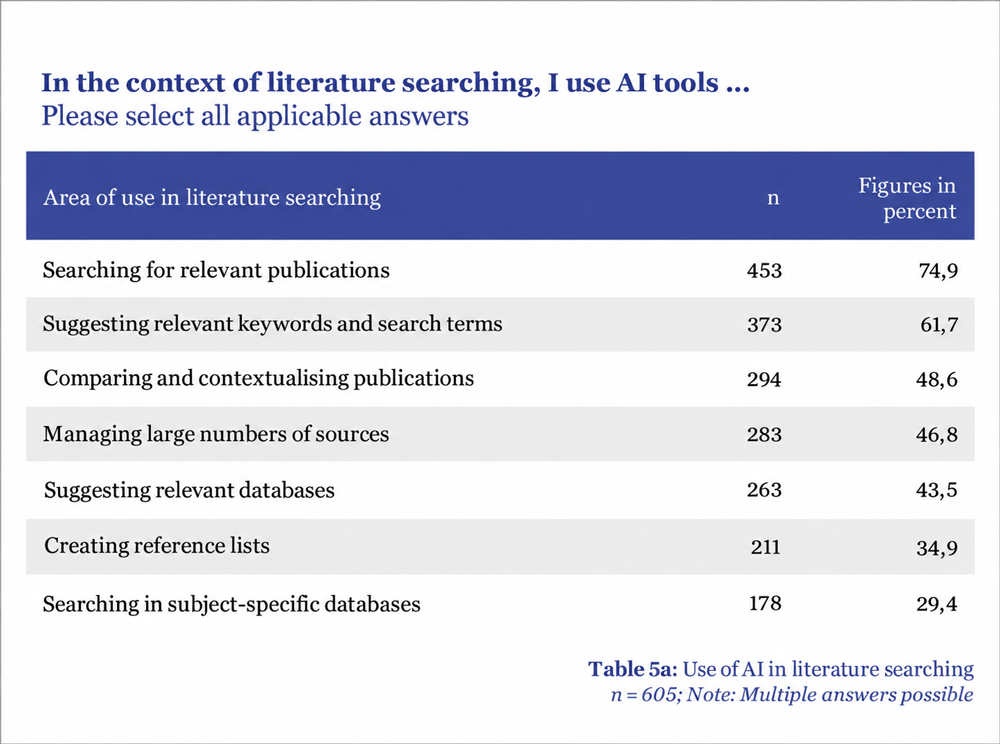
As a result, the boundaries between researching, learning and writing are becoming increasingly blurred. Within a single session, a chatbot can suggest search terms, provide references, summarise a text and outline initial lines of argument. For libraries, this means, among other things, that information literacy can no longer be taught effectively without taking AI-assisted research practices into account.
At the same time, the students surveyed are clearly aware of the risks. 92.4 per cent recognise the danger of inaccurate or hallucinated results, and 69.8 per cent are concerned about becoming overly dependent on AI. Awareness of risk, however, is not the same as the ability to respond to it. Knowing that ChatGPT can invent references does not necessarily mean being able to identify such errors systematically, verify sources or assess the quality of an AI-generated answer from a subject perspective.
This is precisely where libraries have an important contribution to make. Students need an understanding of what AI can do, but above all they need reliable methods for critically evaluating its output.
Long-standing challenges remain
Despite all the attention currently focused on generative AI, the ZBW study also shows that fundamental challenges in academic research persist. 62.5 per cent of respondents find it difficult to access the full text of academic publications, and more than half (53.6 per cent) have difficulty judging whether a search result is relevant to their research question.
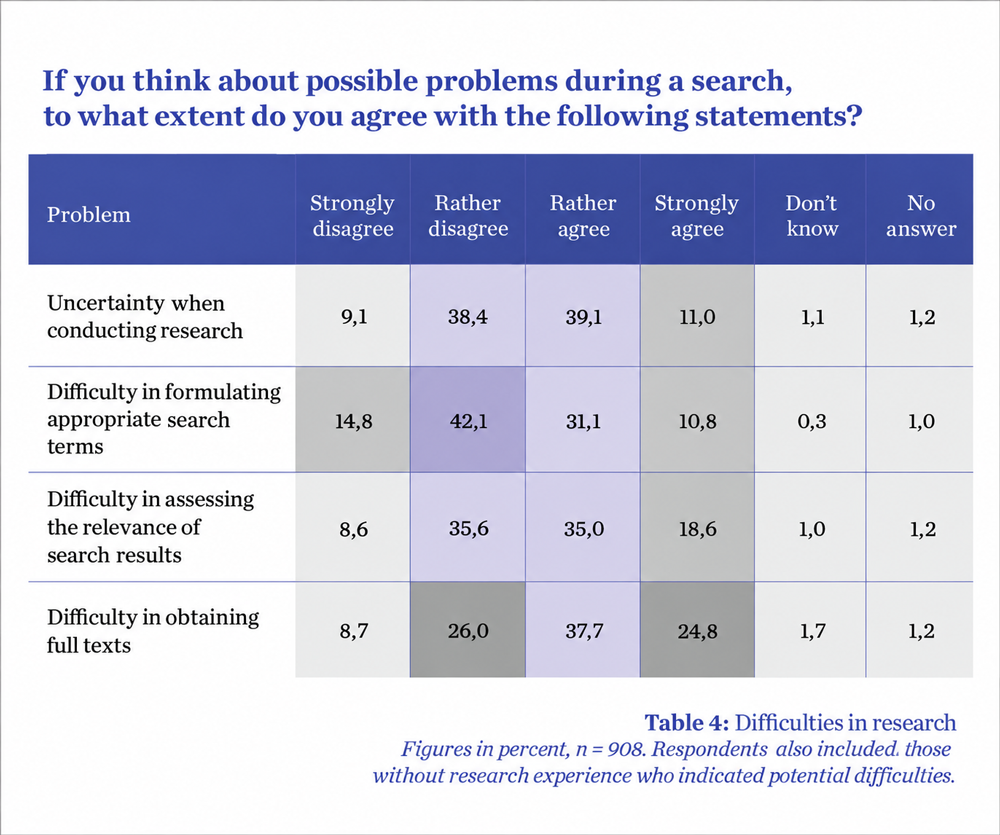
Generative AI does not automatically resolve these difficulties. A plausible-sounding answer is no substitute for access to the original publication, nor for reading and evaluating it critically. The responses to the question of which training content students consider particularly important show that there is still a considerable need for support in this area:
- 92,2 per cent: Correct citation and avoiding plagiarism
- 89,6 per cent: Identifying trustworthy sources
- 81,3 per cent: Using AI for literature searches
- 75,9 per cent: Developing suitable search terms
- 73,1 per cent: Researching using search engines and databases
(Percentages combine the responses “somewhat important” and “very important”.)
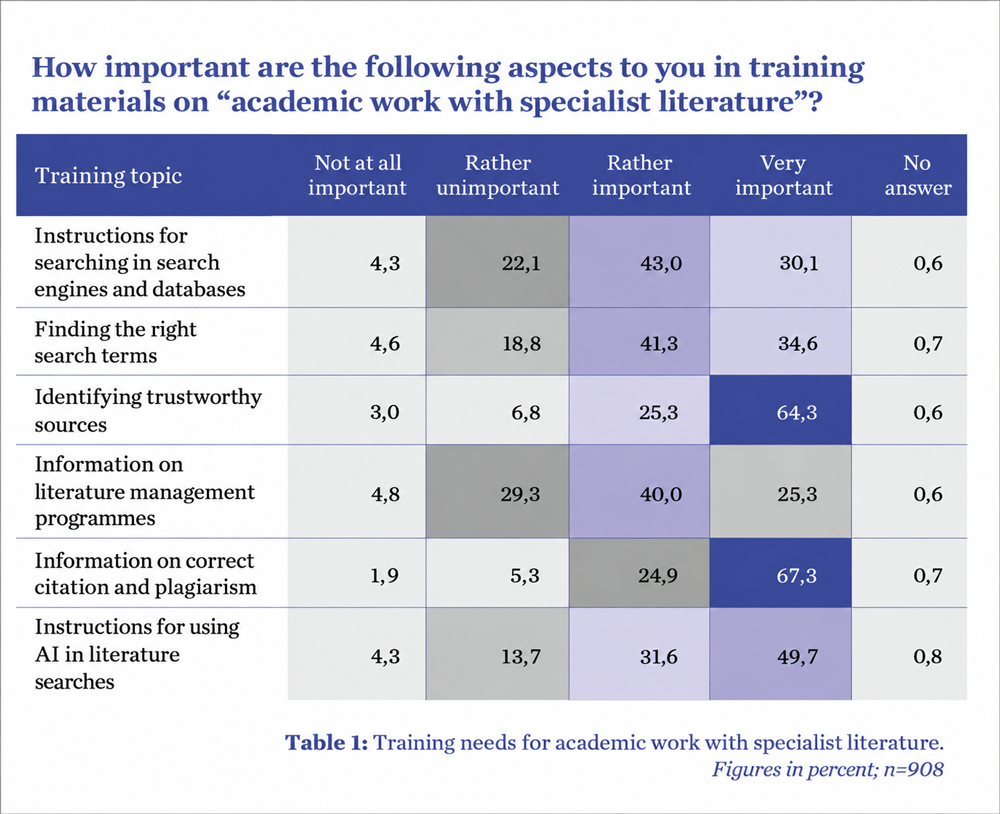
Notably, guidance on using AI for literature searches ranks only third. The students surveyed are therefore not primarily seeking more knowledge about AI. Instead, new technological demands go hand in hand with the established questions of academic information literacy.
What does this mean for libraries?
The results suggest that information literacy and AI literacy should be taught in a more integrated way. The aim should not be simply to add another ChatGPT course to existing training programmes. Instead, students’ actual research and working practices should be considered as a whole and serve as the starting point for library teaching.
This ranges from using AI effectively for initial orientation and turning AI-generated search terms into robust search strategies for specialist databases, through to verifying references, obtaining original publications and critically evaluating results. Not least, it also involves recognising when it is better to read a text oneself rather than rely on an AI-generated summary.
Libraries do not need to start from scratch, as their core expertise is in greater demand than ever. The challenge is to make it visible where students actually conduct their research today.
You may also be interested in / further links:
- Doreen Siegfried und Elisabeth Flieger (2026): „Zwischen Google Scholar und ChatGPT – Wie Wirtschaftsstudierende heute recherchieren“ (German). ZBW – Leibniz Information Centre for Economics
- Information provision for economic research: AI agents, open data and new roles for libraries
- LIBER Conference 2026: Building future-fit libraries between openness and security
- AI in libraries: How libraries can live up to their responsibilities
- Study on AI and Open Educational Resources: Strategic Relevance or Individual Motivation
This text and the tables were translated from German using AI and subsequently reviewed by an editor. Unless otherwise stated, this text and the graphics are licensed under the licence CC BY-NC-ND.
Dr Doreen Siegfried is Head of Marketing and Public Relations at the ZBW – Leibniz Information Centre for Economics. She can also be found on LinkedIn.
Portrait: ZBW©
Unless otherwise stated, this text and the graphics are licensed under the CC BY-NC-ND licence.


Künstliche Intelligenz und Informationskompetenz: Über die Kunst, einen Brokkoli zu vierteln
Barcamp Open Science 2026: Navigating Challenging Times

Horizont-Bericht 2020: AI, XR und OER setzen sich langsam in der Hochschulbildung durch
View Comments
ZKI/DINI Annual Conference 2026: Data Centres and Libraries Joining Forces
How can research infrastructures become sustainable and independent enough to enable...