Information Provision for Economics and Business Research: Between AI Agents, Open Data and New Roles for Libraries
Around 60 subject specialists from Germany and Switzerland came together in Kiel to discuss the future of information provision for research in economics and business studies. From AI agent systems that carry out research independently and new ways of certifying reproducibility, to infrastructure for research data and the significance of consortia: this blog article looks back on two days full of fresh ideas for library practice.
by Joachim Michel, Guido Scherp and Anna Wiese (ZBW)

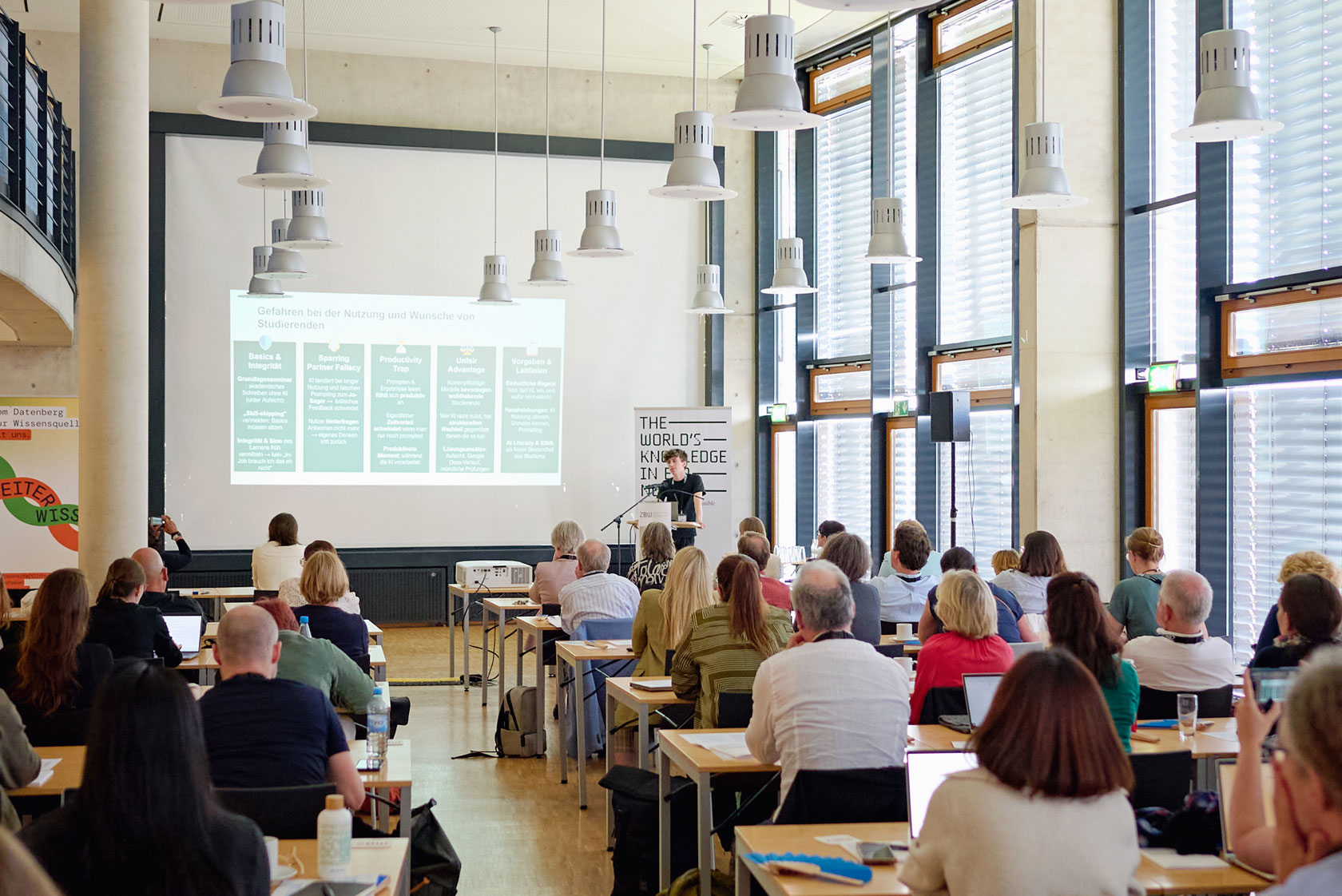
On 9 and 10 July 2026, the ZBW – Leibniz Information Centre for Economics, together with the German Association of Librarians (VDB, German language), hosted the conference “Information Provision for Economic Research: Between Data, Openness and AI“ (German language) in Kiel. Around 60 subject specialists and staff from academic libraries across Germany and Switzerland took part in this well-established conference series, whose audience has broadened over the years. In her opening remarks, ZBW library director Christiane Müller emphasised the importance of this exchange in better meeting the needs of the shared target group and, for example, improving the day-to-day advisory work carried out in libraries. Müller therefore set out her aim for the conference: to address the three thematic areas – AI, Open Science and research data – in a practical manner and always within the context of economics and business studies.
AI: Between Agent Systems and Academic Integrity
The conference began with one of the most hotly debated topics right now: artificial intelligence. As in the other sessions, the presentations on this topic brought together a wide range of perspectives.
Professor Doris Weßels, former professor of business informatics, founder of the “Teaching and Learning to Write with AI“ competence centre and head of the “Generative AI Future Lab“, is one of Germany’s most prominent AI experts in education and higher education. In her keynote, “AI in Science and Research: From the Status Quo to the Future of Agentic Research Support“, she traced how rapidly the field has developed since ChatGPT launched in 2022, moving from simple, “reactive“ chatbots to increasingly complex, “proactive“ AI agent systems.
Weßels used several striking examples to show just how realistic the idea of AI conducting research independently has become. The Japanese AI system Sakana, for instance, managed to publish a fully AI-generated paper, which was later flagged accordingly and retracted. A doctoral thesis written by AI in only four days raises the question of whether it is still worth writing a thesis oneself. Weßels herself also tests the capabilities of AI agent systems. In April this year, she had several AI agents independently search for publications on AI research agent systems, assess their potential, and produce a complete paper from the results. She rated some of the resulting papers as “quite respectable”.
Weßels did not stop at simply taking stock. She also highlighted the challenges this development poses for the research system, some of which she discusses in this column (PDF in German language). The traditional publication process, she argued, can barely keep up: peer review and editorial work are designed around human working times, not the few days in which AI agent systems can now produce a complete paper. As a result, quality assurance becomes weaker. This allows more unlabelled, AI-generated fake academic papers to be published, such as those produced and sold by “paper mills”.
Another problem, she noted, is the political bias found in various AI models (German language). If researchers accept such “assessments” without questioning them, values and opinions can creep unnoticed into supposedly neutral scientific statements.
The erosion of critical thinking and academic integrity through the use of AI is also a concern for Henry Lange, an economics student at the University of Hamburg. He uses AI himself to manage his workload. In his talk (PDF in German language) he offered a critical reflection on the impact of AI on higher education and students. He observes two types of students: some use AI to achieve the best possible results, whilst others use it simply to pass their courses. Lange considers it problematic that both groups are simply seeking to minimise their effort. After all, anyone who merely wants to save work through AI will eventually stop developing and questioning their own views. This is exacerbated by AI models which, with prolonged use and incorrect prompts, tend to confirm ideas rather than scrutinise them critically. Furthermore, AI puts students who cannot afford more powerful models at a disadvantage. Lange would like to see universities standardise their guidelines on the use of AI. In addition, “AI literacy” should become an integral part of the curriculum. This is where libraries have an important new role to play; for example, they could offer courses on “good prompts for literature research”.
For Professor Ragna Seidler-de Alwis, professor of business information and market intelligence at TH Köln, the growing use of AI in research is also a double-edged sword. Through efficiency gains and improved data analysis, AI tools can benefit applied business research, for instance in market and competitive analysis. Yet human expertise and intuition remain essential for interpreting results critically, skills that Seidler-de Alwis also sees at risk from growing AI use. She is also concerned about how persistently sensational misinformation and disinformation can circulate, spreading even faster with the help of AI. This is exactly where academic libraries could step in, by actively helping to refute such false information.
The overarching message of all three presentations in this session was that AI is here to stay and that using it responsibly is now more crucial than ever. The topic’s prominence was also evident off stage: in the interaktiven session with flash talks and posters, AI dominated much of the conversation.
Open Science: Reproduction and Replication Despite Restricted Data Access
Open Science in economics and business studies was also examined from two very different perspectives. Lars Vilhuber, Data Editor for journals of the American Economic Association (AEA), approached the topic from an economics viewpoint. His focus was on reproducibility, that is, the exact repeatability of research findings. Sören Köcher Professor of Business Administration, on the other hand, considered replication from a business administration perspective, in which research findings are re-examined in a different context.
In his talk, Vilhuber focused specifically on data to which access is restricted for valid reasons – such as data protection – and which consequently makes replication more difficult. As a data editor, he experiences this problem first-hand: in 2025, the underlying data was freely accessible for only 38 per cent of the 384 articles under review. The remaining 62 per cent were subject to access restrictions. This raises a key question: how can reproducibility be credibly demonstrated, even if the data itself is not accessible? As a possible solution, Vilhuber proposed certifying successful reproduction at the source, carried out by a trusted body able to examine even restricted data within a protected environment. Early approaches already exist, such as the Certification Agency for Scientific Code and Data (CASCaD). Even so, a “transparency gap“ remains – that is, a lack of insight into the actual reproduction process itself. This is precisely the gap that the research project TRACE (TRAnsparency CErtified) aims to close. The framework is designed to make every stage of the reproduction process traceable without having to re-run the code, for example through complete provenance documentation.
Sören Köcher showed just how illuminating replication can be from a researcher’s point of view (PDF in German language). He has carried out several replications himself, and used concrete examples to demonstrate that a failed replication does not automatically mean the original study was wrong. More often, it shows that an effect simply cannot be observed under changed conditions, which in turn helps to understand the limits of that effect more clearly. Open Science makes replication easier, according to Köcher, but replication studies themselves should also be as open and reproducible as possible. Here too, restricted data access, as outlined by Vilhuber, creates limitations. There is also a structural problem: journals favour novel findings, so replications generally have fewer chances of being published there.
Research Data: Transparent Research Needs More Than Infrastructure
The question of how to build trust in economic research when the underlying data cannot be shared also ran through the third thematic block of the conference: research data management. Here too, various perspectives were explored.
Philip Raatz a research data manager at the FDZ Ruhr, drew on his own advisory experience (PDF in German language) to explain the role research data centres (RDCs) play here. Building on Vilhuber’s idea of certification “at the source“, he described how RDCs provide exactly the kind of institutionalised space needed when reproduction is not possible through openly shared data. RDCs supply the economics and business studies community with quality-assured data products, reduce the cost of everyday research work, and ensure long-term access to data, even where direct publication, for instance for data protection reasons, is not possible. Among other things, Raatz advises RWI researchers on producing “replication packages“, now required by an increasing number of major journals. A common misunderstanding concerns Open Data: here, “open“ usually only means “free of charge“, not “freely usable“. Researchers should therefore check terms of use and licences carefully before using such data.
Sven Vlaeminck showed what kind of infrastructure academic journals themselves can provide to help close the reproducibility gap. As the ZBW’s research data management officer, he has over ten years of experience building and running a publication-related data archive (PDF in German language). Through the Journal Data Archive (JDA), the ZBW operates a web application that allows journals to submit research data linked to an article, enrich it with metadata and assign it a DOI. Vlaeminck’s key insight after ten years: policies alone are not enough. They also need to be enforced consistently and made mandatory. Otherwise they remain without effect. So far, there are no consistent standards for data policies, particularly for replication packages, nor sufficient recognition for publishing research data as a scholarly achievement in its own right.
Jordi Murcia Serra and Ellis Kolb from BERD@NFDI, the NFDI consortium for Business, Economic and Related Data, based at Mannheim University Library, likewise stressed that infrastructure alone does not suffice. Their contribution (PDF in German language) focused mainly on the training perspective: alongside a wide range of services for unstructured and semi-structured research data, BERD places particular emphasis on the BERD Academy. Its free training courses on research data management are designed to enable the community to actually make use of the infrastructure that has been built.
Cooperation: Towards Nationwide, Free Information Provision
Free information provision for research in economics and business studies in Germany cannot be achieved by a single institution alone. In his talk (PDF in German language), Jens Lazarus, head of collection management at the ZBW, showed what large-scale cooperation can look like in practice. As the lead consortium institution, the ZBW negotiates around 50 consortium agreements on behalf of almost 500 research institutions across Germany, taking on tasks such as preparing offers, managing metadata and archiving.
According to Lazarus, Open Access transformative agreements present a particular challenge. As lead negotiator for the Taylor & Francis consortium, the ZBW is currently negotiating the continuation of the Publish and Read agreement from 2027 onwards. These negotiations, he said, sit in the tension between science-policy ambitions and the realities of negotiation, which are shaped by the needs and financial means of the participating institutions. The DEAL agreements serve as a blueprint here, with their continuation from 2029 already being prepared by the DEAL Task Force. Lazarus also pointed to the “Wirtheke“ mailing list which could in future also be used to communicate about highly specific ZBW consortium offers, such as primary economic databases.
The final talk (PDF in German language) made clear that Diamond Open Access too, where neither authors nor readers pay for publication, depends on collaboration between many institutions. Ronja Kuhlwilm (ZBW) presented Open Library Economics (OLEcon), a consortium of libraries, foundations and universities through which the ZBW supports scholar-led journals publishing under this model. One distinctive feature: the title rights of the funded journals belong to the academic community, not to commercial publishers. Seven journals are currently being funded in this way, financed by consortium members and the BMFTR (Federal Ministry of Research, Technology and Space). Bente Steinecke (ZBW) discussed the topic from the perspective of SeDOA (German language), the central German contact point for Diamond Open Access. She pointed to a more fundamental, often unresolved question: who actually holds the title rights to a journal when there is no clear rule in place? A legal opinion is intended to bring clarity on this in future.
What Christiane Müller had encouraged in her opening remarks – an exchange of ideas about what these developments actually mean for everyday work in libraries – was ultimately delivered by all thematic blocks. From AI literacy, through research data management advice, to helping shape Open Access structures: this year’s conference brought not only fresh ideas for participants’ own practice, but also new contacts for further exchange and collaboration.
This text has been translated from German.
Joachim Michel is a academic librarian at the ZBW – Leibniz Information Centre for Economics, responsible for German-language monographs and indexing economic literature. He is part of the STW Thesaurus editorial team.
Portrait: Joachim Michel©
Dr Guido Scherp is head of the “OpenScienceTransfer” department at the ZBW – Leibniz Information Centre for Economics. He can also be found on LinkedIn and Mastodon.
Portrait: ZBW©, photographer: Sven Wied
Anna Wiese has a background in economics and the philosophy of science and works in the “Open Science Transfer” department at the ZBW – Leibniz Information Centre for Economics as an Open Science Editor. In this role, she focuses in particular on the Open Economics Guide”. She can also be found on LinkedIn.
Portrait: Anna Wiese©
Photo: ZBW©

Open Access Survey in Greece: Status Quo, Surprising Findings and Starting Points

DGI Day Practicum: How Does Artificial Intelligence Change the World of Information Professionals?

A Self-Experiment in Fake Science: The Tricks of Predatory Journals
View Comments
Barcamp Open Science 2026: Navigating Challenging Times
The resilience of Open Science and the attribution and disclosure of AI were,...