Study on AI and Open Educational Resources: Strategic Relevance or Individual Motivation?
Open Educational Resources are not yet being used in higher education to the extent originally anticipated by many. What role could the use of AI applications play in the development, use and further development of OER? How can AI help to promote the dissemination of OER? A new study highlights the great potential – and reveals significant differences in the perception of the strategic importance of both topics.
by Birgit Fingerle (ZBW)

Although OER are regarded as a central component of modern higher education teaching, and a wide range of new advisory services, funding schemes, digital platforms and infrastructures have already been established and developed around the topic, their use in everyday higher education has so far fallen far short of expectations. A new interview-based study investigated the extent to which their development can benefit from the rapid spread of generative artificial intelligence (AI).
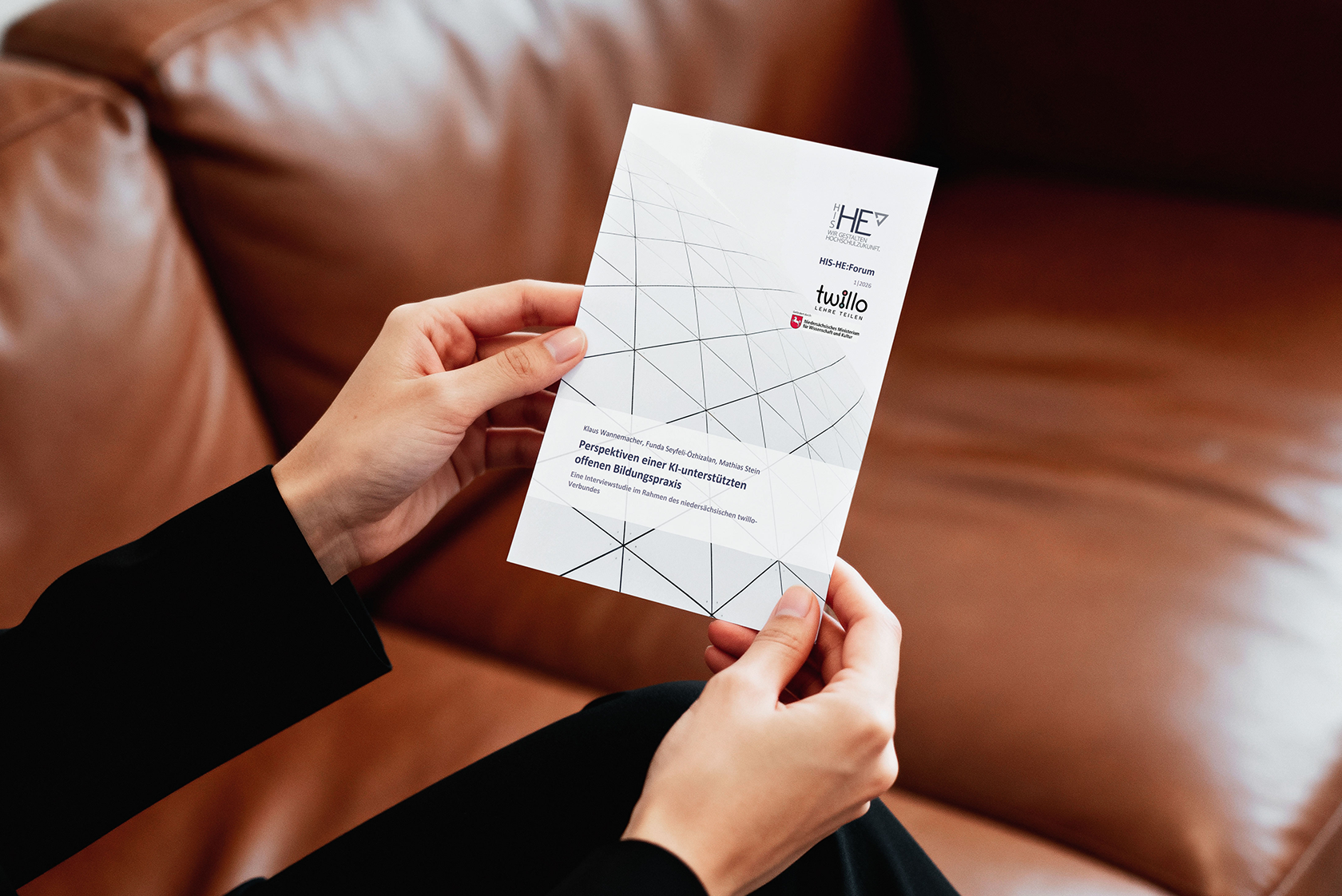
Together with partners in the twillo consortium, the HIS Institute for Higher Education Development (HIS-HE) published the study, “Perspectives on AI-supported Open educational practice” (Perspektiven einer KI-unter¬stützten offenen Bildungspraxis) (German language) at the end of May 2026. The study is based on an exploratory mixed-methods design that systematically integrates quantitative and qualitative data collection and analysis methods. The survey polled lecturers, university management, early adopters and experienced users of OER in German-speaking countries.
Great potential, low uptake
The results confirm the considerable potential of AI applications in Open Education, particularly in terms of increasing efficiency in OER development and updating, adapting to different learning needs, and improving accessibility. This potential has not yet been sufficiently exploited. The practical use of AI in the OER sector is currently limited mainly to individual initiatives and its application to text correction, translation and image generation. More sophisticated fields of application are still rare in German-speaking countries. These may include, for example, AI-supported personalisation of OER, but also automated metadata generation, adaptive learning pathways or AI-based assessment systems.
Further key findings reveal strategic and structural gaps, including a lack of clear internal university guidelines on AI. Skills gaps and legal uncertainties, particularly around copyright and data protection, are also holding back AI use. Many respondents feel poorly informed and see an urgent need for training.
Recommendations for unlocking the potential
With regard to Open Educational Resources, the cultural barriers at universities are greater than the technical hurdles. OER are ‘relatively unknown’ to many. As the survey results also show, the topic of OER is apparently viewed more as an individual task for lecturers, as a voluntary additional commitment on the part of individual lecturers. In contrast, the use of AI is predominantly regarded as a strategic issue for the university as a whole. In this respect, it is hardly surprising that it is individuals within universities who are experimenting at the interface of AI and OER and driving development forward.
The recommendations for university practice and development derived from the study therefore cover the following topics:
- Curriculum planning and skills development: Integration into the teaching landscape
- Higher education pedagogy: Quality development and use cases
Higher education governance: Strategic anchoring and infrastructure
Central contact points, reliable advisory structures and improved metadata and infrastructure solutions are considered helpful. They could support the discoverability, reusability and quality assessment of OER. Furthermore, open communication at all levels could help to consolidate existing individual initiatives and align them strategically.
You might also be interested in:
- Open Educational Resources: Open Economics Guide now Covers More Topics
- AI in Libraries: How Libraries can Live Up to Their Responsibilities
- Artificial Intelligence and Information Literacy: On the Art of Quartering Broccoli
- AI Inspirations for Libraries: From Study Bots to Conversations with Books
- Promptathons: Potential for Libraries – and for Open Science?
This text has been translated from German.
Birgit Fingerle holds a diploma in economics and business administration and is among other things involved in ZBW MediaTalk and innovation management and is part of ZBW’s equal opportunities team. Birgit Fingerle can also be found on LinkedIn.
Portrait, photographer: Northerncards©


What Libraries Can Learn from Mendeley

Teaching Open Science: Slide set Supports Lecturers

Review: How the Economic Impacts of Open Science are Being Measured
View Comments
Open Science Happy Hour: A Cocktail Recipe Makes Good Research Tangible
How do you introduce a topic like Open Science at an academic conference without...