ZKI/DINI Annual Conference 2026: Data Centres and Libraries Joining Forces
How can research infrastructures become sustainable and independent enough to enable digital sovereignty in academia? At the 2026 ZKI/DINI Annual Conference at RWTH Aachen University, data centres and libraries came together to discuss Open Source, the future of Open Access and the use of AI in science. A review of three presentations and a panel discussion that exemplify the breadth of topics covered at the conference.
by Olaf Siegert (ZBW)

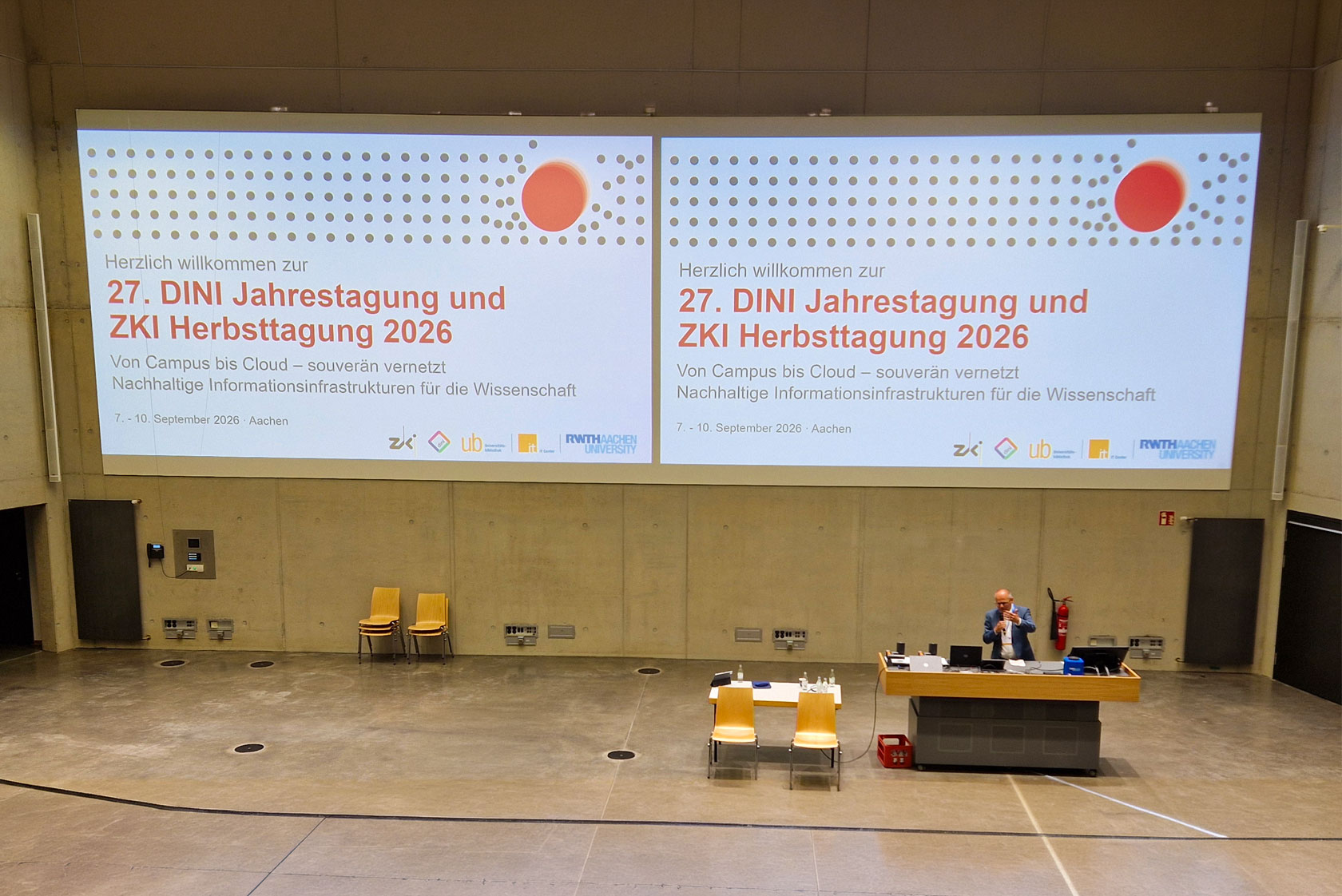
From 7 to 10 September 2026, the 27th Annual Conference (German) of DINI (German Initiative for Networked Information), an association of libraries, media centres and IT services, took place. This year, the conference was held in conjunction with the autumn conference of the ZKI (German), a network of IT services at universities, technical universities, universities of applied sciences and research institutions in Germany. Over 300 participants gathered at RWTH Aachen University under the motto “From Campus to Cloud – Confidently Connected”. The focus was on how sustainable information infrastructures for science can be designed and further developed.
The nearly 20 presentations and one panel discussion (see the full programme here) covered a broad range of topics: from National Research Infrastructure (NFDI) and the National High-Performance Computing Consortium (NHR Consortium, German), to resilient research infrastructures, and on to Open Access and academic publishing from an international perspective, including contributions from Belgium and the Netherlands. To illustrate this breadth of topics, three presentations and the panel discussion “Joint Pathways to Digital Sovereignty” are examined in more detail below.
Resilient Infrastructures Instead of “Projectitis”
In the first presentation, “Performance through Responsibility: On the Recommendations of the RfII”, Petra Gehring (TU Darmstadt), as former chair of the Council for Information Infrastructures (RfII), began by tracing the Council’s history: founded in 2014, it advises the federal and state governments in Germany, as a science policy body, on the further development of digital and scientific information infrastructures, and has since published numerous position papers, discussion papers and reports. The talk focused on the 2025 position paper “Performance and Responsibility: On the Future of Scientific Information Infrastructures in Germany” (German), in which the RfII calls for a well-coordinated, functionally integrated system of information infrastructures for science – one that covers not only research data but also research software and hardware, computing power, storage capacity and digital skills, right through to questions of digital sovereignty in research on an international scale. Gehring called for an analysis of the shortcomings in current practice, clear governance rules with well-defined institutional responsibilities (“ownership”), and transparent procedures for either continuing or discontinuing services. She criticised “projectitis” – the tendency to think in terms of short-term third-party funding cycles – arguing instead for stable, long-term funding of established infrastructures, as well as better career paths and pay for the staff who run them. In her view, science policy, research funders and the institutions operating the infrastructure all share equal responsibility for implementing these recommendations.
Open-Source Software as a Response to Political Dependence
In his talk “Resilient Research Infrastructures for Open and Digitally Sovereign Science”, Konrad Förstner (ZB MED) discussed the central role of research software, which is used across almost every stage of the research process. A key problem, he noted, is that services are often discontinued once project funding ends, or that the software developed in these projects is no longer available. Initiatives such as the non-profit organisation Software Heritage can help by archiving software and making it citable. Another challenge is the political dependency built into publicly funded services and infrastructures: a shift in the scientific policy landscape can quickly create bottlenecks in financial funding. Relying on proprietary software from private service providers is particularly risky when data ends up stored in countries with a fraught research-policy environment. Furthermore, long-standing dependencies often arise in this context. Förstner therefore made the case for using free software (or Open-Source software), pointing to NFDI and EOSC as examples of good practice. In the second part of his talk, he turned to the role of artificial intelligence (AI) in science, highlighting a lack of transparency in processes and the frequent absence of reproducible research results as major concerns. This is particularly challenging in software development, where faulty code cannot easily be corrected after the fact. In conclusion, Förstner advocated for the widespread use of FLOSS (Free, Libre and Open Source Software), whilst AI should only be used with great caution and under close scrutiny.
Open Research Europe 2.0
Michael Geuenich (DFG) presented the publication portal „Open Research Europe“, launched by the European Commission in 2021 as a free Open-Access platform for publications from EU-funded projects. To date, 6,300 authors from 3,000 institutions have published more than 1,500 articles on ORE. Five years on, the portal is being placed on a broader footing: a total of 17 institutions – mainly national research funders such as the DFG, along with several ministries – are now involved in financing and governing the service. Going forward, it will be hosted at CERN in Geneva and run on the Open Journals System (OJS), an Open-Source software platform. The publishing model will be „Publish – Review – Curate“: where all submissions will be published first as preprints and only then go through peer review. In future, any article from a European research institution will be eligible for publication, regardless of whether it received third-party funding. The relaunched ORE is set to go live in October this year. The participating funders – in Germany, the DFG, for instance – will be responsible for promoting the service. Members of the audience suggested that the DFG’s expert panels should also be involved in the planned outreach campaign.
Digital Sovereignty as a Joint Endeavour
The panel discussion “Joint Paths to Digital Sovereignty”, moderated by Christoph Koitka-Fieke (Hochschulforum Digitalisierung / HRK), brought together Lars Bernhard (TU Dresden), Konrad Förstner (ZB MED / TH Köln), Petra Gehring (TU Darmstadt), Matthias Müller (IT Centre, RWTH Aachen) and Dietrich Nelle (formerly BMBF, now a strategy consultant).
Topics included the challenges digital sovereignty poses for academic institutions, as well as how shared goals, coordinated initiatives and workable governance structures might be developed. Discussion centred on what digital sovereignty actually means, how different stakeholders should work together, and the right degree of centralisation. Regarding the NHR initiative presented earlier, it was noted that high-performance computers operated in Germany alone were not sufficient for data sovereignty – genuine self-sufficiency would also require components manufactured in Germany. On the subject of Open-Source software, Förstner argued that broader adoption of Open Source was failing primarily due to inexperienced advocates. Bernhard countered that over 90 per cent of researchers at TU Dresden use Microsoft or Apple products rather than free software. In the engineering sciences in particular, there remains strong support for “stable” proprietary tools. Furthermore, as he pointed out, even Open-Source solutions are not immune to external attacks. Speaking from the universities’ perspective, he advocated a pragmatic, moderating approach, particularly as the switch to open software – such as Office products – involves transformation costs that many universities would rather share collectively than shoulder alone.
On the use of AI in higher education, panellists criticised the lack of coordination between institutions, which has resulted in a patchwork of policies and locally hosted LLM solutions. Given how new the topic still is, there appears to be genuine uncertainty over who is responsible for what, along with a wait-and-see attitude among many decision-makers. Professional associations, too, were seen as having a role to play in moving the conversation forward.
Overall, the ZKI/DINI Annual Conference left the impression that the challenges facing IT services and libraries are only growing more complex, not less. That made the exchange between senior staff from both communities all the more valuable – both for their own institutions and for the academic system as a whole.
This text was translated from German using AI and subsequently reviewed by an editor.
You may also be interested in:
- Barcamp Open Science 2026: Navigating Challenging Times
- Information Provision for Economics and Business Research: Between AI Agents, Open Data and New Roles for Libraries
- LIBER Conference 2026: Building Future-Fit Libraries Between Openness and Security
- AI in Libraries: How Libraries can Live up to Their Responsibilities
- Council for Information Infrastructures: Performance in Responsibility. On the Future of Scholarly Information Infrastructures in Germany, Göttingen 2025, 61 pp
About the Author:
Olaf Siegert heads the Publication Services Department of the ZBW – Leibniz Information Centre for Economics. He is also active in various committees and networks on the subject of Open Access, including the Leibniz Association, the Alliance of Science Organisations and LIBER.
Portrait: ZBW©


New spaces for Work 4.0 and Learning 4.0: Implications for the Education System?

Open Access Barcamp 2022: Where the Community Met

AI Inspirations for Libraries: From Study Bots to Conversations with Books
View Comments

LIBER Conference 2026: Building Future-Fit Libraries Between Openness and Security
From improving the discoverability of open textbooks and AI-powered FAQ chatbots to...