Barcamp Open Science 2026: Navigating Challenging Times
The resilience of Open Science and the attribution and disclosure of AI were, unsurprisingly, among the most pressing topics at this year’s Barcamp Open Science. At the same time, recurring themes such as incentives for Open Science and Open Educational Resources remained firmly on the agenda. The ever-popular “Open Science Success Stories” series also returned for another round. This blog post highlights the key themes, debates, and ideas that emerged throughout the day.
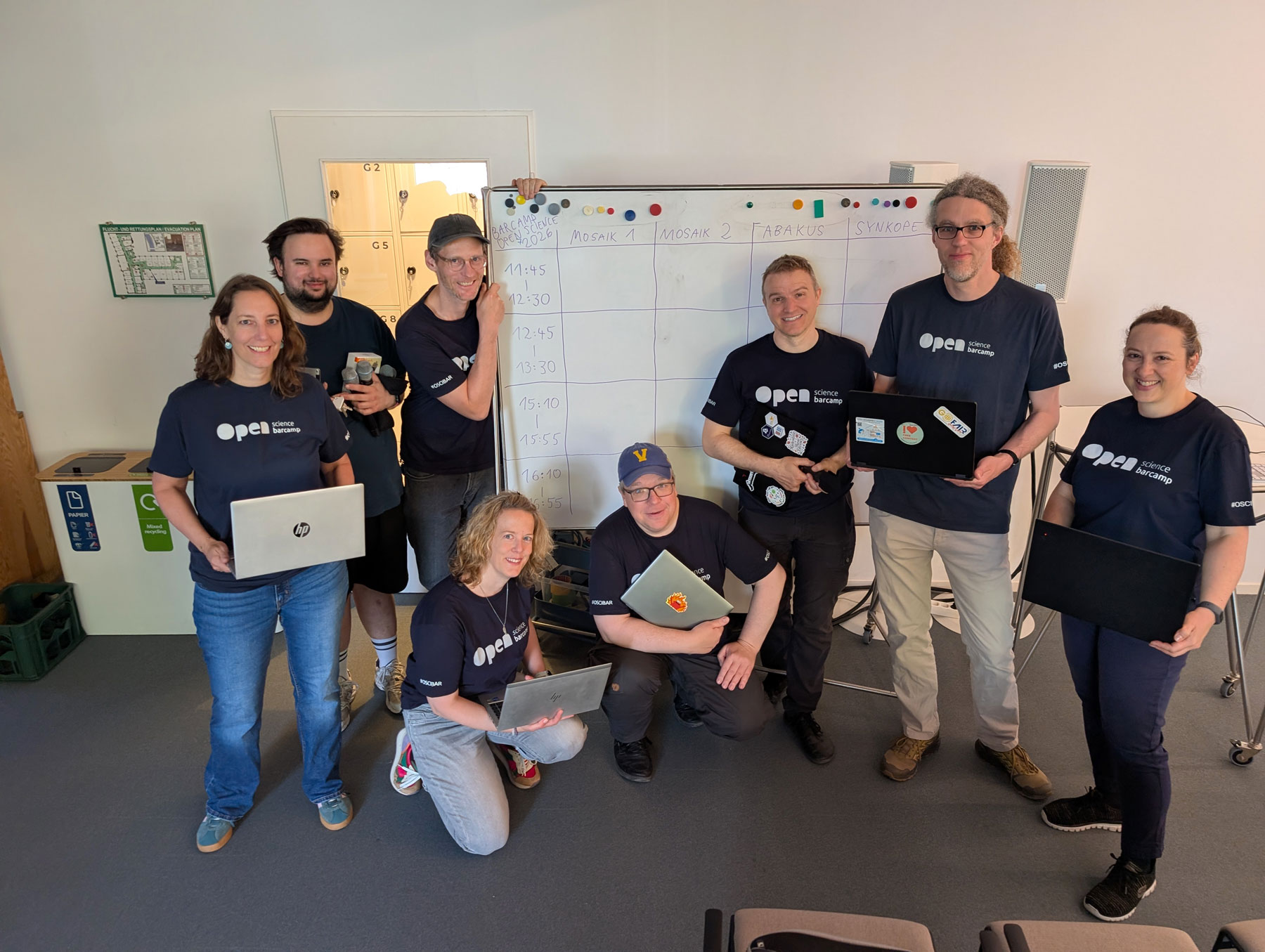
by Susann Auer (TU Dresden), Ben Black (ZALF), Maaike Duine (Open Research Office Berlin), Konrad Förstner (ZB MED/TH Köln), Tamara Heck (DIPF), Ilona Lipp(Universität Leipzig), Tilo Mathes (ResearchSpace), Lisa Poggel (TIB Hannover), Franziska Scharkowski (Otto-von-Guericke-Universität Magdeburg), Guido Scherp (ZBW) and Stefan Skupien (CORe)
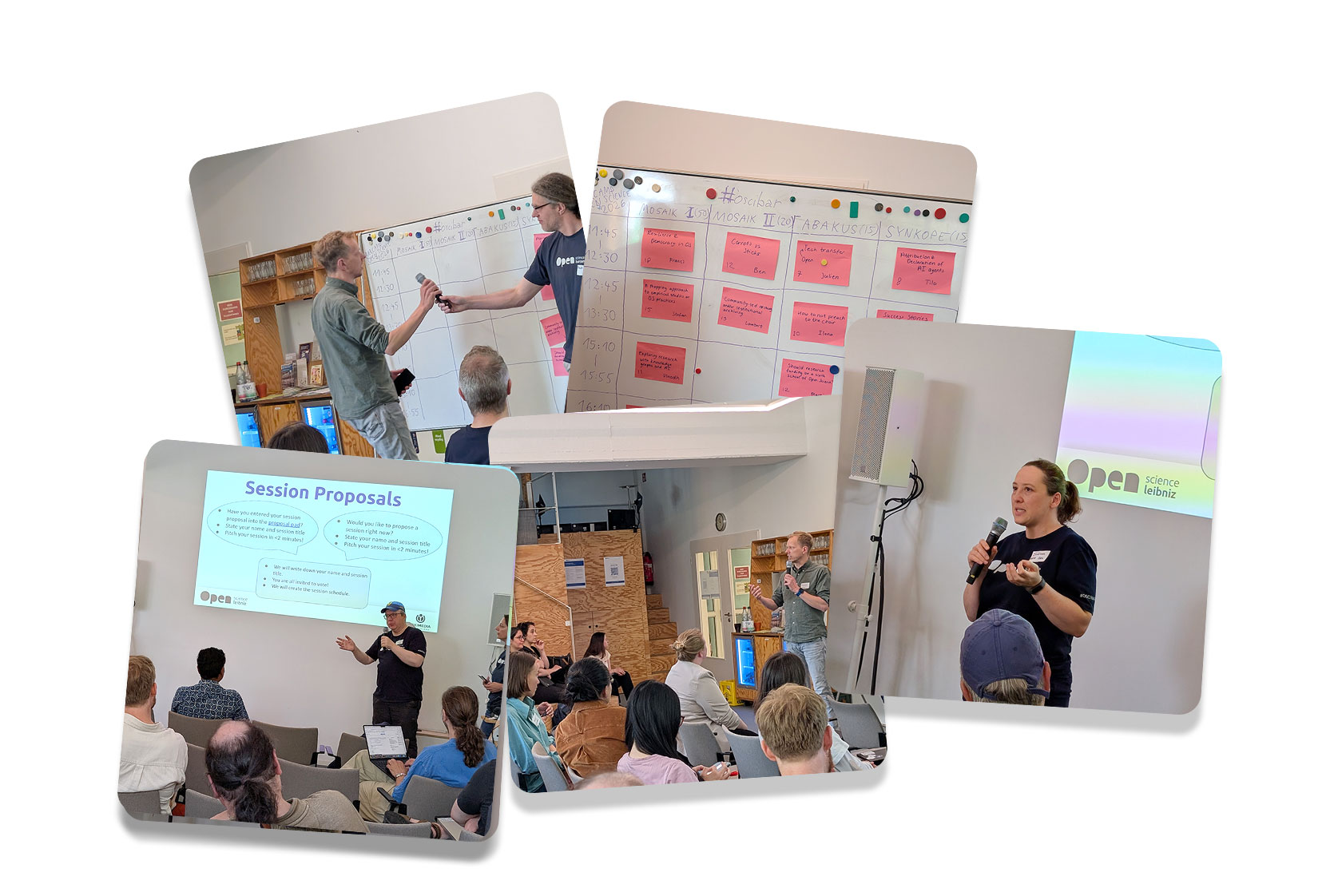
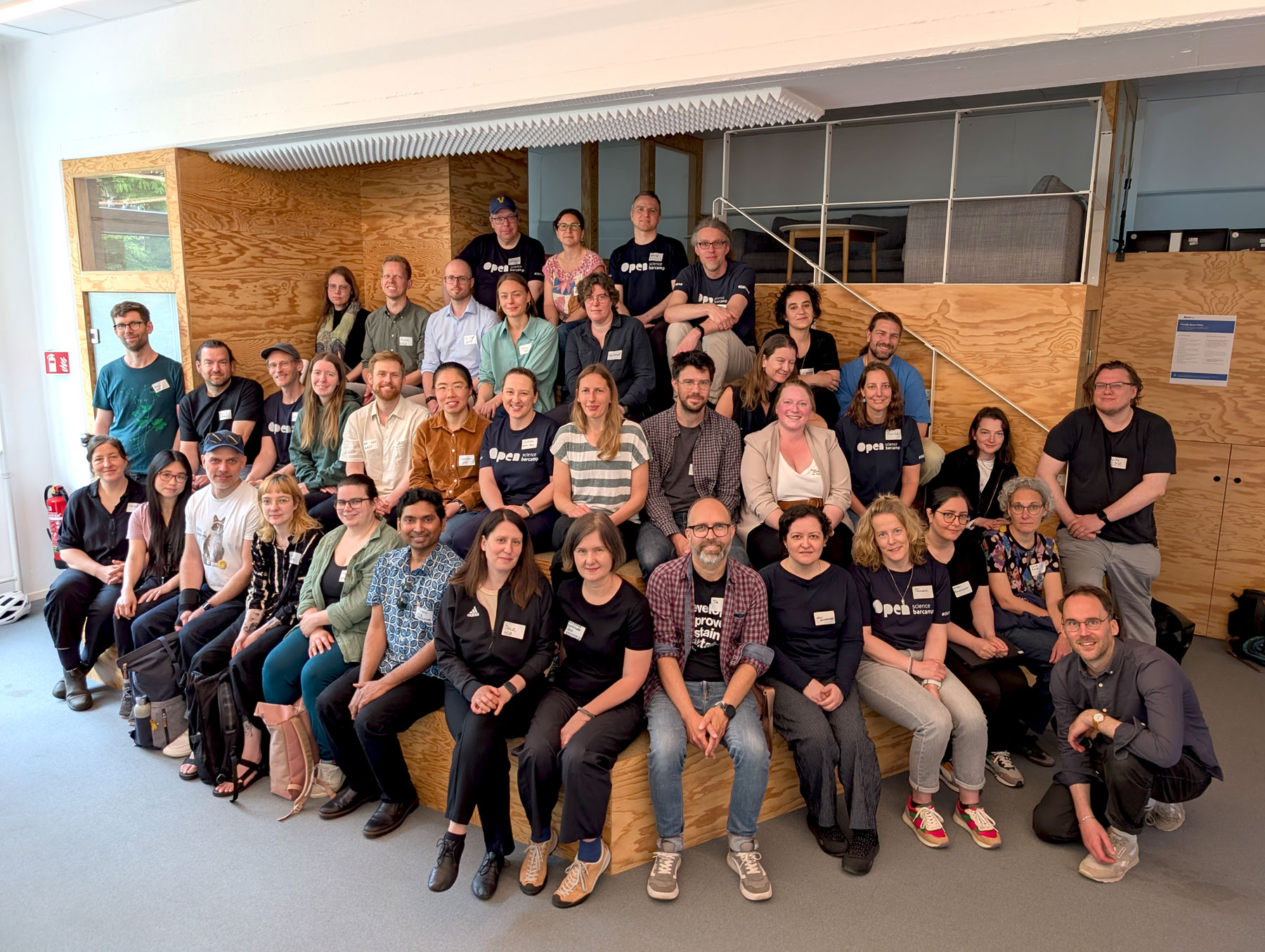
On June 10th 2026, 45 participants gathered for the 12th Barcamp at Wikimedia, Berlin. No matter how far people had to travel – a living statistics exercise revealed that for some, Wikimedia was just around the corner, while for others it meant a journey of several hours – everyone arrived with a shared enthusiasm to connect, meet new people, and exchange ideas on all topics related to Open Science. From resilience and incentivizing Open Science practices, to archiving, data management and even dancing Open Science as a special highlight: Wikimedia’s (dance)floor was sparkling with energy and lively discussions.
The living statistics exercise ignited the first discussions of the day, as participants took sides on the question: is an Open Science future even possible without AI? Opinions were divided, and the discussion could easily have gone on much longer. Konrad Förstner spontaneously stepped in at short notice to replace the cancelled ignition talk, and provided more food for thought on resilience and openness during times of crisis. His talk immediately sparked a lively discussion, with participants sharing their own experiences and perspectives. The participants made statements calling for new approaches, including the development of distributed and federated repositories for research data and cultural goods. They also stressed the need for political action to counter policies that threaten a democratic and science-based society.
The ignition talk inspired the first session proposals of this year’s Barcamp. Some session initiators and contributors have shared their insights and key take-aways in this blogpost.
Resilience and democracy in Open Science
by Franziska Scharkowski
In light of political changes that threaten democracy and academic freedom – currently visible under for instance the Trump administration but also looming in Germany, like in Saxony-Anhalt, where the AfD seeks to influence what should be researched – this session explored how Open Science can become more resilient and, in turn, help strengthen democracy. Saxony-Anhalt served as a case in point: a research-weak state with the lowest share of GDP spent on research funding among German states and generally low public support for science. Participants discussed a state-wide Open Science initiative that is already planned, though state funding is currently blocked ahead of the September state elections (Landtagswahlen). Networking with comparable structures (Open Research Offices in Berlin, Brandenburg, Saarland, NRW) and research networks such as Max Planck was also proposed.
Two core themes emerged: funding for Open Science and building public trust in science. On funding, ideas included joint archives, NFDI, the European Open Science Cloud, and TIB’s decentralized, BitTorrent-based SHIELD project. On trust-building, proposals centered on bringing scientists closer to the public – especially to rural areas, which make up much of Saxony-Anhalt – alongside citizen science approaches and combining scientific literacy with political empowerment to counter science skepticism and help people distinguish fact from misinformation.
Strategically, university leadership was encouraged to proactively engage with politicians, and institutions were seen as potential voices against extremism and restrictions on academic freedom. Underused instruments such as UN treaties (notably Article 15 of the ICESCR, PDF) and the UNESCO Recommendation on Open Science were also mentioned. An open question remained: should the Open Science community become more political – and if so, how, without merely “preaching to the choir”?
Learning from effective carrots and sticks - how to incentivize people
to do Open Science?
by Ben Black
Participants reflected on how institutions, funders, and journals are trying to encourage Open Science, and why these efforts still often fail to change everyday practice.
Many “carrots”, such as recognition and career credit, were still seen as largely hypothetical because their promised benefits rarely materialise. For example, Open Science may be discussed during tenure-track hiring, but carries little weight in final decisions. Participants also noted that disciplines and institutions are at very different stages of Open Science adoption, meaning that no single incentive model will work everywhere.
At the same time, “sticks” such as funder mandates, legal obligations, and institutional expectations are often weakly enforced. Participants pointed to funder requirements for data management plans, which are rarely followed up or checked for compliance. Participants from “sticky” institutions with top-down legal obligations also observed that staff still look for ways to avoid publishing data because they fear that imperfections will become visible.
The discussion concluded that both carrots and sticks remain necessary, but neither will be sufficient without broader cultural change. Participants highlighted that the pace of science may need to slow down rather than continually adding new expectations. To address “error culture”, they suggested promoting the idea, in the spirit of George Box, that “all data are imperfect, but some data are useful”. Finally, participants argued that researchers should be more confident in badging their work as Open Science and framing it as a fundamental component of good science.
Attribution & declaration of AI Agents in research and research data management
by Tilo Mathes
The session asked what happens to the research record if synthetic or AI-treated data quietly enters it undeclared by humans and agents alike. Participants worried about a growing flood of “AI slop” contaminating research datasets, so that future analyses and models are built on undisclosed machine-generated content. The group also noted that AI-introduced bias extends beyond text generation into literature search, data analysis and even study design.
They agreed that disclosure matters, but setting a threshold for when and how AI use must be declared is hard. AI-computed or synthetic datasets already exist in fields like genomics, and enforcement is messy. Two concrete ideas emerged: research instruments such as sequencers and microscopes could cryptographically sign or watermark the data they produce, marking it as AI-free at the source. And content-derived identifiers like the ISCC (International Standard Content Code, ISO 24138) could help persistently identify digital content and carry origin declarations across systems.
Instead of chasing a precise boundary, the group converged on a pragmatic principle: be honest about what you used, and make it explicit. A short reflective statement on risk of bias was seen as more meaningful than a bare “AI was used” checkbox. Simply archiving prompts was viewed as limited, given that the same prompt can yield different outputs, but documenting which model was used can support bias assessment. Ideally, tools like electronic lab notebooks capture such provenance automatically, making room for reflection as the core of responsible AI documentation.
A mapping approach to empirical studies on Open science practices
- what does the community need?
by Stefan Skupien, Tamara Heck, Maaike Duine
This session focused on providing a literature dataset including empirical research on Open Science practices and discussing its use for informing daily Open Science advocacy work or further science studies. In 2020, a group of scholars from the DACH-region started to annotate published research from 2000 to 2020 to capture Open Science practices, methods, disciplines, and target groups, as well as countries of studies, to gain insights in international developments of Open Science. The literature collection and mapping will be continued and expanded for the following years.
The question to the participants, who were Open Science advocates and researchers, was hence, what information on Open Science practices they need in their daily work and how the team could take these needs into account to enrich the dataset. One recommendation was that use cases or comparable good practices of Open science and its operationalisation would be a major contribution. Furthermore, the systematic survey could reveal more about trends and emerging Open Science topics that matter for science management.
Another topic centered around meta-science questions and methods: For instance, it is yet not clear whether Open Science is emerging as an independent field of study. Additionally, the team will have to check for opportunities to include the growing annotated dataset into larger Knowledge Graphs projects, to be explorable and usable for meta-scientists and Open Science practitioners alike.
How to not preach to the choir
by Ilona Lipp
Various types of events exist where Open Science is promoted, discussed, and advanced – such as the Barcamp. People who attend these gatherings are often already familiar with the topic and in favor of pushing the Open Science agenda. However, a (literally) critical mass is needed to achieve the cultural changes required for Open Science to become the norm rather than the exception.
So how do we involve academics and other stakeholders who are not yet interested in, or may even be critical of, Open Science? In this session, we identified some relevant target audiences and then decided to further focus on university students training to become teachers. We employed an empathy mapping approach, visualizing what our target audience does, hears/sees, thinks and feels. This was then the baseline for discussions around how to practically engage this group.
We worked out that prospective teachers do not get a lot of input on didactics, are under a lot of pressure and also get confronted with current political developments. Engagement of this target audience should center on offers that sound attractive and does not seem like additional workload. We speculated that a promising approach would be to offer them practical tools for scientific literacy instruction and for demonstrating the benefits of science to students. Other highly relevant topics may be Open Educational Resources and the debate of “knowledge (and school books) as a public good” (which led to the Barcamp-Session Open Educational Resources for schools).
Open Science Success Stories IV
by Susann Auer
In this year’s edition of this recurring session (edition 4 already!) we were a small group of people mainly from the natural sciences. The goal of an Open Science success stories session is to round up experiences and positive examples of successes that we or others achieved by embracing Open Science practices, tools and patterns of thought. We hope these success stories inspire and can serve as good practice examples to help get more people on board in doing Open Science.
Here are three of the success stories shared this year:
- The Human genome project as an example of an Open Access project that started in 1990 and was a huge collaborative effort to sequence the human genome with the data being made available together with the publications.
- The trailblazing life science journal “eLife” that trained researchers through its ambassador program to apply Open Science principles in their work and communities, an effort that led to career boosting opportunities for many of the ambassadors and continues to shape the way they approach their work.
- Increased visibility of a researcher and successfully applied Open Science principles that made data publication easier through coverage of a project in a newspaper.
Our key outcomes of this session were that through trailblazers from the past that demanded and applied Open Science principles we can now see the positive effects and reap the benefits such as easier data publication and increased visibility.
Open Educational Resources for schools
by Konrad Förstner
The session examined the frequent replacement of school books, which are mostly proprietary and rarely available in digital formats. Participants discussed why this happens and how the situation could be improved. Although not a core Open Science topic, the issue involves similar stakeholders, such as publishers. The group envisioned school book content evolving into Open Educational Resources (OER), maintained by a community and potentially supported by commercial entities. These resources would be freely accessible online under open licenses, easily adaptable, translatable, and continuously developed over time. They could be printed on demand. The main obstacle seems to be the financial incentives for publishers, which currently result in a suboptimal experience for students and the public. The session also highlighted the movement advocating for OER in education and the upcoming OERCamp at the end of August offering a valuable opportunity to connect and advance the cause.
Open for change
by Lisa Poggel
The starting point for this session was the recurring topic of data rescue and the resilience of research data infrastructures. Efforts to create a decentralized infrastructure for cooperatively safeguarding research outputs, for instance using BitTorrent, introduce new challenges for research data governance. When the original repository where a research output was published goes down, the data governance mechanisms associated with it may also become unavailable.
The session therefore asked which situations may pose governance challenges in a decentralized, openly networked infrastructure. In a small group, we identified several scenarios: publishing a new version of a dataset, requesting corrections to metadata and the replicated metadata files, for example, if a researcher changes their name; or even temporarily restricting access to research outputs that may endanger their creators in situations of political repression.
Growing together in challenging times
There seems to be an unwritten rule at the Barcamp Open Science: every year, about half of the participants are experienced regulars, while the other half are attending for the first time. Our Barcamp Open Science bubble continues to grow.
Over the years, different topics have come and gone. Together, we have discussed numerous challenges and explored ways to further advance and promote Open Science. This took place in an environment in which the idea of Open Science and its practices seemed to be gaining ground slowly but seemingly unstoppable.
However, authoritarian tendencies and geopolitical crises are placing increasing pressure on Open Science and on science as a whole. At the same time, the rapid rise of AI is creating new challenges, for example with regard to the reproducibility of research results.
These developments were also addressed at this year’s Barcamp Open Science. Yet they did not dominate the event, and certainly not in a gloomy or discouraging way. Instead, participants took the opportunity to engage in thoughtful discussions about possible responses to these complex and tough challenges.
At the same time, there was also room to look ahead. A dedicated session explored the future of the Barcamp itself. As a result, we are already looking forward to 2027 with great anticipation, fresh ideas, and new team members on board.
Stay tuned!
This might also interest you:
- Open Science Retreat Insights: Can Open Science Survive Authoritarianism and Geopolitical Tension?
- Barcamp Open Science 2025: From Threats to Collective Resilience
- Open Science Conference 2025: Shaping a Bright Future for Open Science and AI
- Open Science Happy Hour: A Cocktail Recipe Makes Good Research Tangible
Susann Auer is a plant scientist at TU Dresden and gives workshops in reproducibility in research with the community-led initiative Reproducibility for Everyone. She is a member of the steering committee of the German Reproducibility Network (GRN) which works to increase trustworthiness and transparency in science. You can find her on LinkedIn and Mastodon.
Ben Black (ORCID) leads a working group at the Leibniz Centre for Agricultural Landscape Research (ZALF) that supports scientists in research data & software management as well as data visualisation and scientific transfer with the goal of encouraging teams to develop as an Open Science Community of Practice. You can follow his latest work via his website or LinkedIn.
Maaike Duine (ORCID) works at the Open Research Office Berlin on the BUA Open Science Magnifiers project, in which she works together with various communities to develop Open Science indicators and visualisations for Open Science monitoring purposes.
Konrad Förstner (ORCID) is joint professor at ZB MED – Information Centre for Life Science and TH Köln – University of Applied Sciences. He is also co-host of the Podcast Open Science Radio. You can find links to his activities and further information can be found on his website.
Tamara Heck is leader of the unit information management at the Information Centre for Education at the DIPF. She co-organises #oscibar and is member of the Leibniz Strategy Forum on Open Science, where she currently investigates how policy papers impact the development of Open Science practices.
Ilona Lipp is the Open Science Officer at the University of Leipzig and a freelance trainer and coach, helping scientists navigate academia and optimise their research practices. You can contact her on LinkedIn.
Tilo Mathes currently works as Product Manager and Open Source Lead at ResearchSpace, where he supports the team to develop the research data management solution RSpace and the open-source community around it. He can be found on LinkedIn, Bluesky, and Mastodon.
Lisa Poggel currently works as a data engineer and research data manager on the project SHIELD at the TIB Hanover.
Franziska Scharkowski (ORCID) holds a PhD in neuroscience and now works at the Office for Research and Research Infrastructure at the Medical Faculty of the Otto von Guericke University Magdeburg. She leads the Open Science Initiative at the Medical Faculty (Medizinische Fakultät/Universitätsklinikum Magdeburg A. ö. R. – Open Science als Transferinstrument, German language) and a project focused on improving animal research and enhancing transparency around it. She can be found on LinkedIn and Instagram (@franzitogo).
Guido Scherp is head of the “Open Science Transfer” department at the ZBW – Leibniz Information Centre for Economics. He can also be found on LinkedIn and Mastodon.
Stefan Skupien (ORCID) works as scientific coordinator for Open Science at the Center for Open and Responsible Science of the Berlin University Alliance. He oversees the development and implementation of alliance-wide policies and strategies to foster Open Science and leads the Open Science Ambassador-programme.
Photos, photographer: Ralf Rebmann©

Wikimedia 2030: Mit Bibliotheken zur größten Wissensinfrastruktur der Welt
Open Science in Research Projects: Library Supports from Grant Proposal to Final Report
A Self-Experiment in Fake Science: The Tricks of Predatory Journals
View Comments

Academic Journals: Visibility in Challenging Times
In an era characterised by the platform economy on the one hand and political demands...