
Open Science Retreat Insights: Can Open Science Survive Authoritarianism and Geopolitical Tension?
Authoritarian tendencies, geopolitical conflicts, and growing concerns about research security are putting Open Science under increasing and unprecedented pressure. At the 10th Open Science Retreat, international experts and practitioners discussed how open research can remain resilient in times of such crises. This blog post highlights key insights from the discussions and proposes actionable steps at the individual, organisational, and policy level to safeguard transparent, trustworthy, and collaborative science.
by Anna Maria Hoefler, Guido Scherp and Sven Vlaeminck (ZBW)

On May 6 and 7, 2026, the tenth Open Science Retreat brought together around 40 participants from approximately 20 countries to discuss the future of Open Science amid authoritarianism, geopolitical tensions, and aspirations for data sovereignty. The retreat addressed growing challenges posed by disinformation, science scepticism, authoritarian tendencies, and geopolitical conflicts, which increasingly threaten academic freedom, international collaboration, and the availability of open research infrastructures and materials. Because of the highly sensitive nature of this topic, such discussions are frequently restricted to confidential spaces, particularly in regions like the US, where researchers might fear that speaking out publicly could negatively influence their careers.
At the heart of the retreat’s discussions was how Open Science can be sustainably preserved and strengthened as the standard mode of scientific practice under these conditions, and what role data sovereignty and alternative approaches might play in addressing these challenges.
Setting the stage: The three keynote presentations
To set the stage for the topic, the retreat featured three keynote presentations given by three international experts. Peter Suber (Senior Advisor on Open Access and Director of the Harvard Open Access Project, USA) gave a striking and deeply concerning overview of the concrete measures the Trump administration is taking against US research. These included the removal of data sets, the halting of data gathering projects, the closing of agency programs, the termination of approved research grants, the cutting of funding for repositories, the freezing of funds for universities, the banning of certain terms, the dismissal of experts from government agencies, the denial of visas for researchers, and the obstruction of international cooperation. Suber has been tracking these measures since the first Trump administration, documenting them on a publicly available wiki page. Against this backdrop, he argued for an open infrastructure that allows uncensored (open) content to be stored decentrally across multiple countries. According to Suber, this could at least protect existing publications from post-publication censorship, although it would not prevent pre-publication censorship or the withdrawal of funding.
Jeroen Sondervan (Program Leader in Open Scholarly Communication, Open Science NL) built on this in his engaging talk by taking a closer look at the resilience of Open Science. He addressed the following questions:
- Will Open Science still be possible?
- Is Open Science resilient and capable of continuing to make science more accessible and engaging, more open to participation and reuse, and more transparent and reproducible?
Sondervan emphasized that the challenges lie in the five major areas: funding, research infrastructure, academic freedom, safety of members of the academic community, and disinformation and skepticism towards science. Sondervan presented a conceptual resilience model that helps to assess which mechanisms or arrangements are in place to safeguard the way we work. This model consists of five types of threat or incursion, ranging from a “potential threat” to the actual “destruction”. The corresponding types of resilience against each of these threats and incursions range from “prevention” to “repair”. According to Sondervan, Open Science is particularly vulnerable because it relies heavily on international collaboration, open infrastructures, and the sharing of data and code. Its societal relevance also makes it more susceptible to political attacks, science scepticism, and technical threats. At the same time, Open Science also possesses particular strengths when it comes to resilience. Open licences and open-source technologies make it easier to mirror, adapt, and restore resources. In addition, Open Science communities are often highly flexible and characterised by a strong “make do” mentality, with many activities relying on volunteer work. Together with his colleague Jeroen Bosman, he published a blog post on this topic and also gave a similar talk at the Open Science Days 2025.
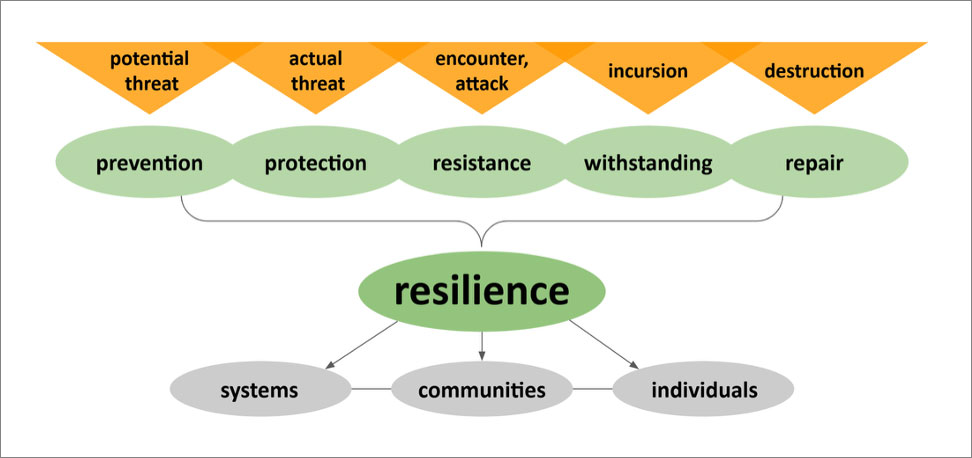
Source: Resilience Model by Jeroen Bosman and Jeroen Sondervan, 2025
Ezra Clark (Chief of Section Science, Technology and Innovation Policy, UNESCO, Paris) provided insights into UNESCO’s ongoing efforts in Open Science. He highlighted the publication of the UNESCO Recommendation on Open Science and its adoption by 194 countries in 2021 as a major milestone in advancing Open Science from a global perspective, an act of collective ambition with a joint understanding of Open Science, and foundational commitments for transforming the whole scientific process.
The recommendation establishes a unique international framework for Open Science policy and practice built around four pillars: open scientific knowledge, open science infrastructures, open engagement of societal actors, and open dialogue with other knowledge systems. According to Clark, the recommendation has been very well received over the past four years. Monitoring mechanisms have been strengthened and awareness of Open Science has increased considerably. 77 member states took part in the first monitoring exercise, proving that concrete steps have been made to integrate Open Science into scientific processes.
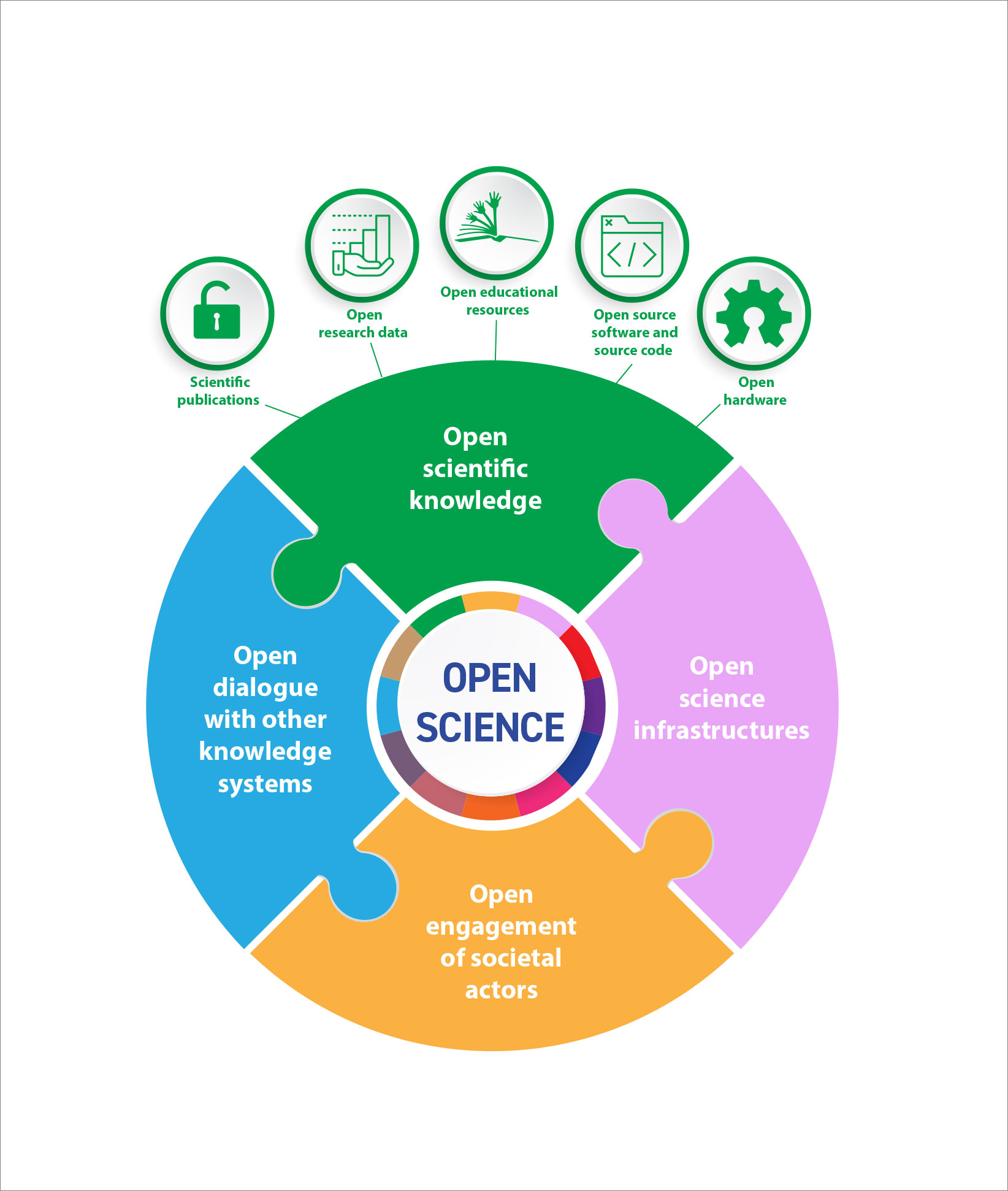
Source: UNESCO Recommendation on Open Science (2021), p. 11. License: CC-BY-SA 3.0 IGO
At the same time, Clark addressed the gap between intention and reality. Specifically, he pointed out the persistent North-South-divide in implementation. A key challenge remains unequal access to infrastructure, emphasising that “Open Science without infrastructure is a vision without practice”. There is the need to invest in structures that make this commitment durable whereas building trust is key now. To support this in the context of the adoption and implementation of Open Science, UNESCO has developed the UNESCO Open Science Toolkit, a collection of practical resources and guidance materials. One of its most recent additions is “Data Policies for Times of Crisis Facilitated by Open Science”, which includes a factsheet, a guidance document, and an implementation checklist.
Inside the Breakout Sessions: Core Themes and Participant Insights
A cornerstone of the retreat were the six breakout sessions held across both days. Based on the participants’ contributions to these discussions, several thematic clusters were identified. Each cluster includes exemplary statements to better illustrate the underlying rationale. Furthermore, each section is introduced by contextually linking it to the overarching theme of the 10th Open Science Retreat.
Balancing Openness and Knowledge Security
Against the backdrop of the retreat’s focus on deepening geopolitical tensions and resulting security concerns, this cluster addresses the perceived conflict between keeping research secure and keeping it open, emphasizing that this tension seems to be artificial and therefore manageable.
- Research Security vs. Open Science: Openness/Open Science is often seen as a counterpart to research security but this tension is artificial. It is important to find a way to show it goes together. We have lots of experience with data protection that can be transferred to knowledge security.
- Understanding perspectives: It is important to understand the needs outside our bubble and across different communities. Example: There are many grass-root initiatives on Open Science by researchers; on the other hand, Open Science meetings are filled with infrastructure managers, not researchers. Combining the knowledge of these two groups could help move forward.
- Openness as a tool for control: Open Science entails experience in deciding what, when, and how to publish. Federated open infrastructure mitigates the vendor lock-in effect. Further aspect: slow down and generate less yet intentional and meaningful data (slow science movement).
Culture, Incentives, and Research Assessment Reform
Recognizing that global crises and authoritarian trends can act as both threats to and catalysts for open practices, this cluster focuses on the human side of academia and the critical need to align career rewards so that Open Science is sustained amidst these global developments.
- Incentives are key: Open Science and the reform of research assessment are not yet well-aligned. This misalignment directly influences issues around knowledge security (for instance due to lacking incentives for careful, intentional data curation). Therefore, incentives and reward systems in science and research need to advance to foster sustainable Open Science practices.
- Values vs. excuses: Open Science is driven by personal and professional values. Current global crises can act both as an excuse to stop practicing Open Science and a reason to be as open as possible. A fundamental question of Open Science is whom we consider our friends or enemies. This also raises the philosophical question of whether we want to share at all.
- The reward system as a shield against crises: Global developments/crises are sometimes used as a cause for not doing Open Science, which underscores the importance of robust reward systems. Teaching, supporting and rewarding Open Science in academia is vital. Example: the Swiss National Open Research Data Prize successfully engages Early Career Researchers.
- The competitive barrier: A competitive environment in research data management persists (“this is my data”, for example, not wanting to give it away for “free”). Here, too, appropriate incentives (such as recognizing data sharing as a scientific contribution) would help to overcome competitive dynamics, at least in part. It is also the mindset towards others that is crucial for sharing information (you might not share information with people you see as competitors). The counter argument here: science is better and more successful in a collaborative way.
Infrastructure, Funding, and Long-Term Sustainability
In response to the concern over endangered research infrastructures and volatile political climates, this cluster highlights the technical, structural, and financial frameworks required to keep Open Science viable without relying on unpredictable government funding.
- Plurality and mirroring: Following Peter Suber’s recommendation, there is a need for a plurality of repositories and platforms for accessing and producing knowledge (for instance, a fusion of Open Research Europe and Zenodo).
- Financial autonomy: Concern over the reliance on government funding, regardless of geography because it is dependent on political developments. Government support for science can change rapidly (as seen recently in the USA), meaning long-term solutions must be independent of government funding.
- Decentralization and trust: What constitutes a “trustworthy” gatekeeper in decentralized infrastructures to mirror content? Do we need decentralized, international funding models? Example: SCOSS.
- Moving beyond basic infrastructure: Infrastructure is key, but it isn’t enough on its own; human expertise is also fundamentally needed.
- Monitoring and impact: Open Science monitoring needs to build on current momentum to prove the concrete impact of current expenditures (for example using tools like the EOSC Observatory). PLOS initiated a study on the economic benefits of Open Science.
Global Inclusivity and Community Interconnection
To counter the potential decline in openness and global collaboration triggered by current geopolitical fractures, this cluster emphasizes the need to build bridges across isolated networks, foster global initiatives, and ensure equity between the Global North and Global South.
- Connecting the disconnected: Communities are currently not well connected but are crucial; we need a coordinated global initiative; building coalitions (diplomacy aspect); understanding the needs of different communities.
- Learning from the Global South: Do not forget the Global South. It operates with less budget and often lacks top-down Open Science policing, offering unique grassroots models we can learn from.
- Cross-functional allyship: Importance of communities in connecting infrastructure staff and researchers (more collaboration needed). We should also connect disparate thematic areas for allyship (for instance, linking Open Science groups with research security groups) to avoid misunderstandings.
Conceptual Clarity, Misconceptions, and Targeted Communication
Tying directly into the retreat’s exploration of “aspirations for data sovereignty”, this category targets the confusing terminology surrounding such concepts, the lack of shared awareness regarding what is at stake, and the strategic communication needed to clarify Open Science goals
- Semantic confusion: The term “Data Sovereignty” has different definitions and is widely seen as problematic or confusing.
- Awareness gap: There is a lack of awareness regarding the challenges and benefits associated with data sovereignty.
- Mitigating doubt: Insecurities around Open Science and misconceptions of what it entails need to be actively addressed and ideally mitigated.
- Targeted communication with established researchers: Communication is key to involving people, particularly established researchers. However, they often hold pre-determined notions on Open Science. Clear communication can clarify what Open Science actually means, what benefits exist and where further incentives are needed. This is vital since established researchers possess the institutional capacity to advocate for it.
What next? Key Takeaways and Actionable Steps
Translating the retreat’s insights into lasting resilience requires a multi-layered approach spanning individual researchers to global policymakers. The following takeaways and actionable steps can provide a practical roadmap to defend Open Science against rising geopolitical pressures and for safeguarding transparent, trustworthy, sovereign, and collaborative research.
Individual level:
Key Takeaway: Personal commitment to openness serves as a crucial buffer against geopolitical crises being used as excuses to pull back from collaborative science.
Actionable Steps:
- Reframe security as data protection: Apply existing data protection and publishing workflows directly to knowledge security concerns to prove the tension is artificial.
- Target peer advocacy: Actively engage established researchers with clear, jargon-free explanations of Open Science to dismantle preconceived biases and mobilize their advocacy power.
- Leverage incentives: Apply for open data awards and recognition programs (like the Swiss National ORD Prize) to build professional visibility, especially for Early Career Researchers.
Organisational level:
Key Takeaway: Expanding technological infrastructure is useless without a parallel investment in human expertise to run it.
Actionable Steps:
- Reform research assessment: Rewrite institutional promotion and hiring criteria to explicitly reward Open Science practices, reducing the competitive “this is my data” mentality.
- Create cross-functional alliances: Form internal working groups that link Open Science teams with research security offices to demonstrate how open practices mitigate vendor lock-in and enhance data integrity.
- Implement repository mirroring: Diversify risk by supporting a plurality of knowledge platforms and establishing regional mirrors of essential repositories (like major US climate databases) to protect data from abrupt geopolitical shifts.
- Keep on teaching and promoting Open Science practises because Open Science is good scientific practise.
Policy and systemic level:
Key Takeaway: Long-term systemic resilience requires shifting away from fragmented, nation-centric funding toward supranational, globally unified, structurally independent frameworks that can withstand volatile political cycles.
Actionable Steps:
A heartfelt thank you goes out to all the participants and keynote speakers for their incredible openness and vital contributions to these crucial discussions. We highly appreciated this valuable exchange, which has provided us inspiration and food for thought to put together this blogpost including the suggestion for a practical roadmap to navigate the future together.
This might also interest you:
This text has been translated from German.
Dr Guido Scherp is head of the “OpenScienceTransfer” department at the ZBW – Leibniz Information Centre for Economics. He can also be found on LinkedIn and Mastodon.
Portrait: ZBW©, photographer: Sven Wied
Dr Anna Maria Hoefler serves as the Science Policy Coordinator at ZBW, where her core areas of focus are research data and Open Science. She can also be found on LinkedIn
Portrait, fotograph: Rupert Pessl©
Sven Vlaeminck is the representative for research data management at the ZBW – Leibniz Information Centre for Economics.
Portrait: FOTO BE’ART Magdalena Taenzle©


Publishing Behaviour in Economics: Coronavirus Pandemic Turns out to Be a Temporary Shock

Opening up Science: How the Library will Become a Hub for Open Innovation and Science

Tracking Science: How Libraries can Protect Data and Scientific Freedom
View Comments

Study on AI and Open Educational Resources: Strategic Relevance or Individual Motivation?
by Birgit Fingerle (ZBW) Although OER are regarded as a central component of modern...